
<

Is Your Food Making You Sick?
If you’re dealing with chronic symptoms that won’t resolve—despite eating “clean,” taking supplements, or trying medication—your food may be quietly fueling inflammation. For many people, the problem isn’t what they’re eating but how their immune system is reacting to it.
The goal is to eat foods without having symptoms
The real issue is not the food, unless you are eating poor-quality food. The issue is how your body responds to food antigens. When our immune system releases inflammatory mediators in response to a food antigen, it is called a ‘loss of oral tolerance,’ and we experience symptoms. These symptoms are commonly called food sensitivities. The ultimate goal is for you to eat quality food without triggering your immune system and having unpleasant symptoms. How we improve your oral tolerance doesn’t matter; we just want to help you get healthy and not be afraid of food.
I always strive to help patients resolve their food sensitivities with acupuncture, nutritional suggestions, and Chinese Medicine first. I most often achieve excellent results, even surprising myself. But if we do not see improvement after 3 or 4 sessions, I will discuss the option of using MRT blood testing to help identify food sensitivities.
Advanced Food Sensitivity Testing with MRT
When needed or requested, I use the MRT (Mediator Release Test) from Oxford Biomedical Technologies to identify hidden immune reactions to foods and food chemicals. Unlike allergy tests, MRT assesses delayed inflammatory responses—responses that can cause widespread, persistent symptoms without obvious digestive distress.
This test is especially helpful for patients who:
- Score high on symptom surveys across multiple body systems
- Have elevated inflammatory markers, such as C-reactive protein (CRP)
- Experience stubborn, multi-system symptoms that don’t respond to standard treatments.
When MRT results are paired with the LEAP (Lifestyle Eating and Performance) elimination diet, many patients experience symptom relief quickly and predictably, often within weeks. But then the goal is to stay symptom-free as more foods are introduced.
Why Food Sensitivities Are So Often Missed
If you’ve tried everything and still feel unwell, it may be that treatments are addressing symptoms—not the root cause.
Research shows that food sensitivities and food chemicals can trigger immune-mediated inflammation, resulting in chronic pain, digestive problems, neurological symptoms, hormonal imbalances, and fatigue. When this occurs:
- Medications may temporarily reduce symptoms but don’t stop the inflammatory trigger.
- Side effects from medications can cause new health issues
- Years may be spent cycling through treatments without lasting relief.
If food sensitivities are driving your symptoms and remain unaddressed, true healing is unlikely—no matter how many therapies you pursue.
“Healthy” Foods Can Still Be a Problem
Millions of Americans have food sensitivities, and many are surprised to learn that even nutritious foods can trigger immune reactions. Foods such as salmon, chicken, spinach, apples, blueberries, and garlic can be problematic for certain individuals.
In fact, one of my patients with multiple sclerosis consistently feels worse after eating blueberries. The takeaway?
There is no universally safe food—only foods that are safe for you.
MRT testing eliminates the guesswork by identifying your personal inflammatory triggers.
Conditions & Symptoms Commonly Linked to Food Sensitivities
Food sensitivities and chemical sensitivities have been associated with a wide range of chronic conditions, including:
- Irritable Bowel Syndrome (IBS)
- Migraines and cluster headaches
- Fibromyalgia
- Crohn’s disease & ulcerative colitis
- Celiac disease
- Chronic diarrhea
- Rheumatoid arthritis
- GERD / acid reflux / heartburn
- Autism spectrum disorders (including Asperger’s)
- ADD / ADHD
- Chronic sinusitis
- Eczema and skin rashes
- Weight imbalances
- Infertility & gynecologic issues
- Chronic fatigue
- Brain fog
- Urticaria (hives)
A Personalized Path to Relief
If food-driven inflammation is part of your health picture, identifying and removing the offending foods can be life-changing. MRT testing allows us to create a highly personalized eating plan—one that supports healing rather than triggering symptoms.
If you’re tired of guessing, cycling through diets, or managing symptoms instead of resolving them, food sensitivity testing may be the missing piece.
I have to admit George, not having to worry about my gut anymore frees up my time to think about other things and notice how worrying about my gut/bowels and my sugar addiction has impaired my day to day life. Thank you so much for all your work with me”
“KF, Medical Practitioner, Boston, MA Used to suffer from IBS, brain fog, & fatigue
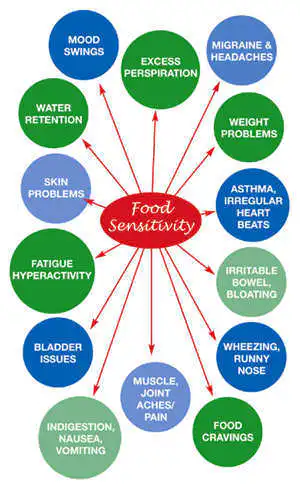
Symptoms that are often related to food sensitivity:
- Diarrhea, Abdominal Pain, Bloating, Distention, Gas, sometimes Nausea & Vomiting
- Heartburn or Gastroesophageal Reflux Disease (GERD)
- Migraine Headaches and Headaches other than Migraine
- Muscle or Joint Pain, Aching, or Stiffness
- General Malaise (feeling lousy), Fatigue, Sleepiness During the Day
- Restlessness, Irritability, Depression, Anxiety, Mood Swings
- Sinus Pain, Runny Nose, Stuffy Nose, Post Nasal Drip, Sore throat
- Skin conditions such as Eczema and Dermatitis
Identifying trigger foods may be difficult for many reasons:
- Food sensitivity reactions may be delayed for hours or even days after ingestion. Even if you suspect food sensitivities, you are unlikely to consider that the headache you have right now was caused by something you ate yesterday.
- Food sensitivities are dose-dependent. This means a small or moderate amount of a reactive food may not cause noticeable symptoms, but a larger amount may. Also, a small amount of a few low-reactive foods can trigger a symptom, whereas one or two of those foods eaten together does not.
- Reactive foods vary widely from person to person, even when they share the same symptoms.
- There are many reactive foods and food chemicals. Sometimes, a preservative or food coloring in toothpaste can contribute to symptoms such as migraines.
*”After the first week on the elimination diet what happened was truly a dramatic and quality of life changer for me. I found that my digestive issues became lessened, bloating diminished, and there were many fewer episodes of stool elimination. My bladder (which had been extremely problematic in the recent past) became much better (like a half an hour to an hour better on average) in holding urine and there has been no leakage. I had had problems with vaginal numbness prior to the diet for years and that has improved.
Mental clarity has been hugely improved; I forget much less often than I used to and have had only one episode of brain fog since the diet started.
Most importantly of all, perhaps, I have had a HUGE increase in energy levels. Prior to this diet, energy was causing me to curtail activities and I was routinely fatigued by 8 p.m. every night. That is not the case now! I can actually stay up at night the way I used to before the onset of the MS…The diet has been a marvelous addition to my life. It has not taken the MS away but it has made it immeasurably easier to live with.”L. – Milford, MA Diagnosed w/Multiple Sclerosis in 2001
Reducing Your Symptoms and Regaining Health
We will have an initial in-office consult so I can understand your health situation. In almost all cases, I’ll perform an acupuncture treatment to determine whether it can provide relief. Most often, it can. If we decide that the best route for you is to get an MRT blood test and follow the LEAP diet, we will use those tools. About 10 days after the blood draw, we’ll have the results and meet to create your personalized LEAP anti-inflammatory diet.
I will help you create a low-inflammatory eating program based on your test results. We can expect that during the first phase of the diet (7-14 days), you will see a significant reduction in your major symptoms (at least 70%). The brilliance of this program is that you will experience firsthand how food affects your well-being. In the future, after completing the dietary program, you should be able to connect symptoms to specific foods you have eaten. It will not only make you healthy but also provide lifelong education.
*”I feel so much more energized and I told Joy this morning that I noticed that I feel happy! Wow. Happy. As you may recall, I was debating going on anti-depressants just before I saw George.”I.C. – Bolton, MA GERD, Headaches


George is a Preferred Nutrition Provider for Blue Cross Blue Shield & HPHC
*These testimonials do not imply that similar results will happen for you by using our services. The testimonials displayed in the text are shown verbatim and in their full length, and no compensation was received in return.tyle=”color:red”>Testing 123